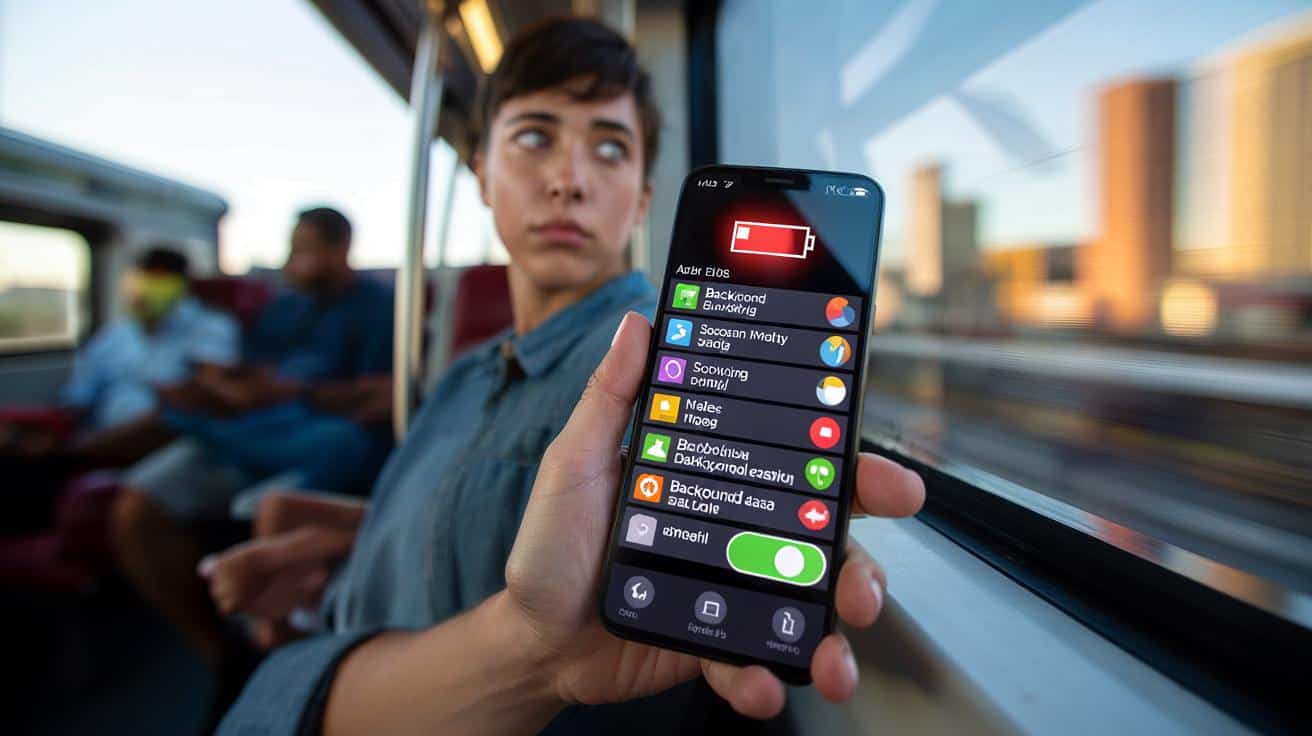
The screen goes black at 23%. You tap the side button, confused, like maybe you misread the number. A second ago your phone seemed fine. Now you’re watching that empty battery icon blink back at you and your stomach sinks. No ride home. No maps. No way to warn anyone you’ll be late. You were on 4G, barely using it, so what on earth drained it so fast?
On the train, at work, in the kitchen while cooking, the same little drama repeats. You unplug at 8 a.m., by 3 p.m. you’re hunting for a charger like your life depends on it. And it’s not just “old phone” fatigue. Quite often, it’s a setting you never really touched.
A setting that quietly eats your battery behind your back.
The hidden setting that quietly burns through your battery
The guilty feature has a friendly name: background app activity. On iPhone it’s called **Background App Refresh**. On Android it’s “Allow background activity” or “Allow background data usage”. Sounds useful, almost helpful. The problem is that when it’s on for everything, your phone never really rests. Apps keep waking up, checking for updates, pulling location data, syncing files.
Your screen might be off, but the phone is still hustling like it’s rush hour. Dozens of apps that you barely open are pinging servers, fetching ads, refreshing feeds. Each tiny action doesn’t look like much. Put them all together, eight, ten, fourteen hours straight, and your battery quietly evaporates.
Think about your own phone. You install a weather app, a game, a shopping app, a new social network “just to test”. You don’t delete them. You barely open them. But deep in the settings, each one got the same default permission: work in the background whenever you feel like it.
A friend of mine was convinced her battery was “dying” and started looking at new phones. Her device wasn’t even two years old. When we opened her battery usage screen, one shopping app she hadn’t used in weeks was somehow responsible for 21% of her drain that day. Just by quietly refreshing offers and notifications.
She didn’t have a battery problem. She had a background problem.
There’s a reason phone makers keep these defaults on. Apps want to reach you first, send the freshest content, keep you hooked. So the system lets them stay half-awake, always ready to buzz your pocket. That kind of constant readiness costs energy.
Your battery isn’t lying when it says 100% at 9 a.m. The issue is what happens between 9 and noon while your phone is in your bag. Those “helpful” background permissions mean your device is basically running a tiny invisible newsroom of apps, all chasing updates, all at once.
➡️ If you feel drained by simple decisions, psychology explains the hidden emotional cost
➡️ How skipping small breaks during the day quietly drains your energy
➡️ How everyday posture affects long-term comfort more than you think
➡️ Psychology explains why emotional awareness sometimes increases discomfort before relief
➡️ People who prefer solitude often process emotions more deeply, psychology suggests
➡️ People who feel pressure to maintain momentum often suppress internal signals
➡️ Psychology explains why emotional safety matters more than logic under stress
➡️ Psychology explains why emotional relief doesn’t always feel pleasant
That newsroom runs on your battery, not on magic.
How to tame background activity without breaking your apps
The good news: you don’t have to turn into a tech nerd to fix this. You just need to be a little bit ruthless with which apps get to run behind your back. The process is simple, whatever you’re using.
On iPhone, go to Settings > General > Background App Refresh. You’ll see a long list of apps. Turn it off entirely, or better, switch it off one by one for anything that doesn’t truly need to update when you’re not using it. News, social, games, shopping, random tools from three years ago – they can all nap.
On Android, open Settings > Battery or Apps (it changes by brand). Tap an app, then “Battery” or “Mobile data & Wi‑Fi”. Disable background activity or background data for everything that doesn’t need to be always on. It feels tedious the first time. Then your battery graph suddenly looks… normal.
There’s a small fear when you start doing this: “If I disable background stuff, will my phone become useless?” Not really. Messaging, email, banking – you can keep those alive if you rely on instant alerts. But do you really need a game to check for promotions at 3 a.m.? Or a food delivery app to refresh 24/7 when you order once a week?
Let’s be honest: nobody really goes through this list every single day. You don’t have to. Spend 15 minutes once, then maybe revisit every few months when you notice a new guilty app in your battery stats. You’ll quickly see a pattern. A handful of apps behave, a handful are greedy. The greedy ones either get restricted or they get uninstalled. Simple as that.
“It felt like getting a new phone for free,” a colleague told me after limiting background activity on a handful of apps. “Same device, same habits, but I still had 35% left at night instead of panicking at 5% at 6 p.m.”
This isn’t about living like a monk with a permanent 10% power-saving mode. It’s about choosing who gets access to your battery. A few practical rules help a lot:
- Turn off background activity for games and shopping apps you don’t open daily.
- Keep it on for messaging, maps, and essential work tools only if you need instant alerts.
- Delete apps you haven’t used in a month instead of just muting them.
- Use Wi‑Fi when you can; background sync on mobile data eats more power.
- Check your battery usage screen once a week, just like you’d glance at your bank account.
Your battery life is not just “bad luck”
Once you see how much energy is lost to this one setting, you can’t unsee it. The idea that “phones just don’t last anymore” suddenly feels a bit lazy. Part of the story is pure physics and aging batteries, yes. Part of it is that our phones are now crowded cities of apps, each one negotiating for a bit of background time.
*You don’t need to become anti-tech to push back a little.* You can keep your social networks, your playlists, your favorite games. You just stop them from secretly emptying your battery when you’re not even looking at the screen. That small boundary changes how your day feels, from the commute to the couch at night.
And once you’ve done it, you naturally start asking other questions. Which alerts really deserve to interrupt you. Which apps you actually enjoy. Which ones just sit there, always on, always hungry. That’s when your phone starts feeling like a tool again, not a demanding roommate with endless needs.
| Key point | Detail | Value for the reader |
|---|---|---|
| Identify the hidden drain | Background app activity (Background App Refresh, background data) | Understand why your battery dies even when you’re not using your phone |
| Adjust per-app settings | Turn off background for non-essential apps like games, shopping, and occasional tools | Gain extra hours of battery life without changing phones or habits |
| Check battery stats regularly | Use built-in battery usage screens to spot greedy apps | Keep control over new apps before they quietly start draining power |
FAQ:
- Question 1Which apps should I definitely keep background activity on for?
- Question 2Will turning off Background App Refresh stop my notifications?
- Question 3How do I see which app is draining my battery the most?
- Question 4Does dark mode really save battery, or is that a myth?
- Question 5At what point is my battery just old and needs replacing?