The first twinge is so slight you almost ignore it. A dull pull between the shoulder blades after a long day at the laptop, a faint stiffness in your neck when you reverse the car, that slow ache in your lower back when you stand up from the couch. You roll your shoulders, stretch once, tell yourself you’re just tired. Then you go back to the exact same position that caused it.
Fast-forward a few years and those tiny twinges have started to vote. Your body keeps the score of every slouch, every twisted sit, every “I’ll just hunch like this for a minute”. And the bill arrives quietly, in the form of chronic tension, headaches, unexplained fatigue.
The strange part is, most of it doesn’t come from the gym. It comes from the way you sit to check your email.
That “just for a second” slouch that never really ends
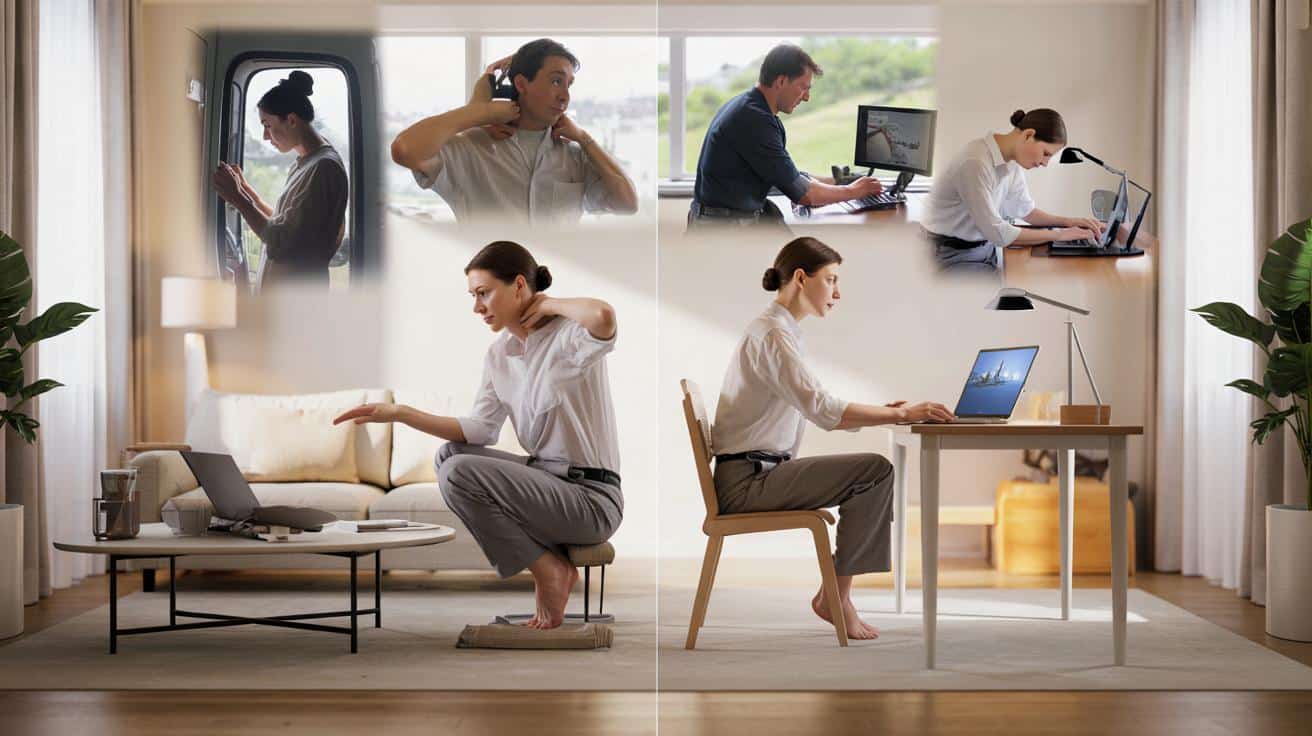
Watch people on a morning train and you can almost read their posture like a diary. One person folded over their phone, chin tucked, shoulders creeping towards their ears. Another twisted half sideways, bags on their lap, spine doing a reluctant C-shape. Across the aisle, someone has turned the seat into a semi-bed, hip pushed forward, neck tilted at an impossible angle.
None of them are in pain right now. They’re just “a bit stiff”. Yet their bodies are quietly adapting to these shapes, day after day. What feels casual today becomes normal for the muscles tomorrow. That’s where long-term comfort starts to shift, without a single dramatic injury.
Picture Emma, 34, who works in marketing. She doesn’t lift heavy things, doesn’t run marathons, rarely misses a yoga class. Still, she wakes up with a sore neck most mornings. Her physio asks how she sits at work. She laughs it off, then sends a photo later: laptop on coffee table, her on the couch, shoulders rounded, chin poked out, one leg folded underneath her. That’s her “temporary” home office for the last three years.
Or think of Mark, the delivery driver. He spends half his day with one hand on the wheel and the other resting on the door. He leans slightly to the left, always, because it feels relaxed. After a decade, his lower back doesn’t agree. One hip has started to carry more of his weight, the other side constantly bracing without him noticing. No big accident, just millions of minutes in the same skewed pose.
The body is a master of adaptation, not a machine that resets every night. Muscles shorten when they’re always held tight, others weaken if they rarely get used. Joints slowly follow the direction they’re being pulled. Nerves can become a little more sensitive when they’re constantly compressed by awkward angles.
That’s why everyday posture, the “nothing special, just how I sit and stand”, shapes long-term comfort more than any occasional workout. An hour of perfect form in the gym can’t completely cancel eight hours of laptop hunching. Your nervous system learns what “normal” feels like from what you repeat the most. If your normal is a slouch, your comfort threshold will eventually bend to match it.
Small posture shifts that quietly change your whole day
Start with the simplest thing: where your head lives. Most of us carry it a few centimetres in front of our shoulders, especially when we’re staring at screens. Gently pull your chin back, as if you’re making a tiny double chin, and let the back of your neck lengthen. That’s closer to where your head naturally balances on your spine.
➡️ I stopped cleaning on weekends and my home stays just as clean
➡️ People who feel pressure to maintain momentum often suppress internal signals
➡️ People who prefer solitude often process emotions more deeply, psychology suggests
➡️ If your phone battery dies too quickly, this hidden setting is probably the reason
➡️ Psychology explains why emotional safety matters more than logic under stress
➡️ How skipping small breaks during the day quietly drains your energy
➡️ This small change helps you stay calm while speaking
➡️ Psychology explains why emotional relief doesn’t always feel pleasant
Then think of your ribcage as a balloon stacked over your pelvis. When you’re sitting, slide your bum slightly back and let your weight rest on the bones under your butt, not on your tailbone. From there, imagine hanging from a thread at the crown of your head. Not stiff, not military, just lightly taller. Five breaths in that position can reset more than you think.
Your feet tell a surprisingly honest story, too. Many people perch on the edge of their chair, toes digging into the floor, heels hovering. The body reads that as a low-level “ready to run” signal and keeps muscles switched on all day. Try this instead: place both feet flat on the floor, hip-width apart, and let your knees point roughly in line with your toes.
If your chair is too high and your feet dangle, your lower back and neck are already doing overtime. Slide a box, stack of books, or even an old shoebox under your feet. It looks trivial, almost silly, yet it gives your body permission to settle. *Posture isn’t just about looking straight; it’s about giving your system places to rest.*
Let’s be honest: nobody really runs a full ergonomic audit every single day. Most of us remember posture only when something hurts. Then we overcorrect, sit bolt upright for five minutes, and collapse back into old habits as soon as our email pings.
The trick is not perfection. It’s adding tiny, repeatable interrupts:
- Stand up every 45–60 minutes, even just for 30 seconds
- Switch your sitting position deliberately a few times an hour
- Bring the screen up to eye level instead of bringing your head down
- Use your phone at chest height sometimes, not always at lap level
- Pick one “anchor habit” (like brushing your teeth) to practise a tall, relaxed stance
These micro-adjustments sound small, almost boring. Yet they compound into less tension by evening, and that’s where comfort starts to shift for real.
A long game with your future self’s body
If you zoom out, posture is less about “sitting straight” and more about how you distribute effort across your body through the years. Each shortcut has a cost, just not right away. The shoulder that always carries the bag, the leg that always crosses over the other, the neck that always turns to the same side to see your second screen. None of this screams emergency today.
But imagine your future self five, ten, fifteen years from now. The version of you who wants to sleep without numb fingers, garden without a burning back, play with kids or grandkids without dreading the floor. That person is quietly shaped by what you do between emails and Netflix episodes. Not by one big decision, by dozens of tiny ones.
| Key point | Detail | Value for the reader |
|---|---|---|
| Daily posture shapes “normal” | Repeated positions teach your muscles and joints what to expect | Understand why minor habits can cause major comfort shifts over time |
| Small adjustments beat big efforts | Frequent micro-changes in sitting and standing reduce constant strain | Gain practical ways to feel better without a full lifestyle overhaul |
| Future comfort starts now | Today’s posture choices influence how easily you move years from now | Motivation to care for your body as a long-term companion, not a short-term tool |
FAQ:
- How do I know if my posture is “bad”?You don’t need a perfect mirror pose. Look for signals: frequent neck or back tension, headaches after screen time, one shoulder always higher in photos, or clothes sitting unevenly. Those are clues that certain areas are working harder than others.
- Can I really change my posture as an adult?Yes, but it’s more about changing habits than “fixing” bones. Muscles adapt all through life. Gentle strengthening, regular movement breaks, and better chair/screen setups can shift your default over months, not days.
- Do I need an ergonomic chair?A good chair helps, but it’s not magic. What matters is that you can sit with feet supported, hips slightly above knees, and back relaxed. A simple chair plus a cushion and a footrest can sometimes beat an expensive setup used badly.
- Is standing all day better than sitting?All-day anything is rough on the body. Long static standing can irritate joints just as much as long sitting. The sweet spot is variety: alternate sitting, standing, and short walks through the day whenever possible.
- How long until I feel a difference if I change my posture?Some people notice less stiffness within a week of moving more and adjusting their setup. Deeper changes, like fewer headaches or less chronic tightness, often take a few months of consistent small tweaks. Think “slow but real”, not overnight miracle.